


 Our Village Montessori
 About Montessori
 Calendar
 Blog
Blog Admissions
 Contact
 Agenda
 Posterboard
  Month
Month  Week
Week  Day
Day November – December 2013

Diwali, or Dipawali, is India’s biggest and most important holiday of the year. The festival gets its name from the row (avali) of clay lamps (or deepa) that Indians light outside their homes to symbolize the inner light that protects us from spiritual darkness. This festival is as important to Hindus as the Christmas holiday is to Christians.
Diwali, celebrated in October or November each year, originated as a harvest festival that marked the last harvest of the year before winter. India was an agricultural society where people would seek the divine blessing of Lakshmi, the goddess of wealth, as they closed their accounting books and prayed for success at the outset of a new financial year. Today, this practice extends to businesses all over the Indian subcontinent, which mark the day after Diwali as the first day of the new financial year.
Indians celebrate with family gatherings, glittering clay lamps, festive fireworks, strings of electric lights, bonfires, flowers, sharing of sweets, and worship to Lakshmi. Some believe that Lakshmi wanders the Earth looking for homes where she will be welcomed. People open their doors and windows and light lamps to invite Lakshmi in.
Over the centuries, Diwali has become a national festival that is enjoyed by most Indians regardless of faith: Hindus, Jains, Buddhists, and Sikhs.
Hindus interpret the Diwali story based upon where they live:
- In North India they celebrate the story of King Rama’s return to Ayodhya after he defeated Ravana by lighting rows of clay lamps.
- South India celebrates it as the day that Lord Krishna defeated the demon Narakasura.
- In western India the festival marks the day that Lord Vishnu, the Preserver (one of the main gods of the Hindu trinity) sent the demon King Bali to rule the nether world.
In all interpretations, one common thread rings true—the festival marks the victory of good over evil.
Non-Hindu communities have other reasons for celebrating the holiday:
- In Jainism, it marks the nirvana or spiritual awakening of Lord Mahavira in Oct. 15, 527 B.C.
- In Sikhism it marks the day that Guru Hargobind Ji, the Sixth Sikh Guru was freed from imprisonment.
Five Days of Diwali
On the first day of Diwali, housewives consider it auspicious to spring clean the home and shop for gold or kitchen utensils.
On the second day, people decorate their homes with clay lamps or diyas and create design patterns called rangoli on the floor using colored powders or sand.
This is the main day of the festival when families gather together for Lakshmi puja, a prayer to Goddess Lakshmi followed by mouth-watering feasts and firework festivities.
This is the first day of the new year when friends and relatives visit with gifts and best wishes for the season.
On the last day of Diwali, brothers visit their married sisters who welcome them with love and a lavish meal.
SOURCE: kids.nationalgeographic.com
Details to follow…
On the 11th hour of the 11th day of the 11th month of 1918, an armistice, or temporary cessation of hostilities, was declared between the Allied nations and Germany in the First World War, then known as “the Great War.” Commemorated as Armistice Day beginning the following year, November 11th became a legal federal holiday in the United States in 1938. In the aftermath of World War II and the Korean War, Armistice Day became Veterans Day, a holiday dedicated to American veterans of all wars.
The Great War & Armistice Day
Though the Treaty of Versailles was signed on June 28, 1919, November 11 remained in the public imagination as the date that marked the end of the Great War. In November 1918, U.S. President Woodrow Wilsonproclaimed November 11 as the first commemoration of Armistice Day. The day’s observation included parades and public gatherings, as well as a brief pause in business activities at 11 a.m. On November 11, 1921, an unidentified American soldier killed in the war was buried at Arlington National Cemetery in Washington, D.C.; the U.S. Congress had declared the day a legal federal holiday in honor of all those who participated in the war. On the same day, unidentified soldiers were laid to rest at Westminster Abbey in London and at the Arc de Triomphe in Paris.
On June 4, 1926, Congress passed a resolution that the “recurring anniversary of [November 11, 1918] should be commemorated with thanksgiving and prayer and exercises designed to perpetuate peace through good will and mutual understanding between nations” and that the president should issue an annual proclamation calling for the observance of Armistice Day. By that time, 27 state legislatures had made November 11 a legal holiday. An act approved May 13, 1938 made November 11 a legal Federal holiday, “dedicated to the cause of world peace and to be hereafter celebrated and known as ‘Armistice Day.'” In actuality, there are no U.S. national holidays because the states retain the right to designate their own, and the government can only designate holidays for federal employees and for the District of Columbia. In practice, however, states almost always follow the federal lead.
From Armistice Day to Veterans Day
American effort during World War II (1941-1945) saw the greatest mobilization of the U.S. Army, Navy, Marines and Air Force in the nation’s history (more than 16 million people); some 5.7 million more served in the Korean War(1950 to 1953). In 1954, after lobbying efforts by veterans’ service organizations, the 83rd U.S. Congress amended the 1938 act that had made Armistice Day a holiday, striking the word “Armistice” in favor of “Veterans.” President Dwight D. Eisenhower signed the legislation on June 1, 1954. From then on, November 11 became a day to honor American veterans of all wars.
The next development in the story of Veterans Day unfolded in 1968, when Congress passed the Uniform Holidays Bill, which sought to ensure three-day weekends for federal employees–and encourage tourism and travel–by celebrating four national holidays (Washington’s Birthday, Memorial Day, Veterans Day and Columbus Day) on Mondays.
The observation of Veterans Day was set as the fourth Monday in October. The first Veterans Day under the new law was Monday, October 25, 1971; confusion ensued, as many states disapproved of this change, and continued to observe the holiday on its original date. In 1975, after it became evident that the actual date of Veterans Day carried historical and patriotic significance to many Americans, President Gerald R. Ford signed a new law returning the observation of Veterans Day to November 11th beginning in 1978. If November 11 falls on a Saturday or Sunday, the federal government observes the holiday on the previous Friday or following Monday, respectively.
Celebrating Veterans Day Around the World
Britain, France, Australia and Canada also commemorate the veterans of World Wars I and II on or near November 11th: Canada has Remembrance Day, while Britain has Remembrance Sunday (the second Sunday of November). In Europe, Britain and the Commonwealth countries it is common to observe two minutes of silence at 11 a.m. every November 11.
In the United States, an official wreath-laying ceremony is held each Veterans Day at the Tomb of the Unknowns in Arlington National Cemetery, while parades and other celebrations are held in states around the country. Veterans Day is not to be confused with Memorial Day–a common misunderstanding, according to the U.S. Department of Veterans Affairs. Memorial Day (the fourth Monday in May) honors American servicemembers who died in service to their country or as a result of injuries incurred during battle, while Veterans Day pays tribute to all American veterans–living or dead–but especially gives thanks to living veterans who served their country honorably during war or peacetime.
SOURCE: history.com
It’s a POTLUCK! Please see the sign up sheet on the wall across from your kiddos’ coat and backpack hooks.
Join us at the school to celebrate Thanksgiving AND Native American Heritage Month by participating in a Smudging Ceremony.
What is a Smudging Ceremony?
HOW TO SMUDGE:
Place cedar, sage, sweetgrass into a clay bowl. Light it carefully and let the smoke start to rise, it carries your prayers to Great Mystery.
Rub your hands in the smoke to cleanse them; scoop the smoke into your hands and bring it to your head, so you will think good thoughts – no anger, jealousy, hate; to the eyes so you will see the world around you in a good way; to the throat so you will speak always in kindness and in non-judgmental ways; to the ears, so that you will listen truly listen to each other instead of ‘waiting to speak’ which we so often do; to the heart so you feel connected to all living beings in a loving way; to the solar plexus so your emotions connect with the Earth Mother; Women to the womb, so your life giving energies go out into the world in balance and harmony.
Finally under the feet, this way the dark side of your soul and the world will not follow in your footsteps.
Native American Smudging

Smudging is a way to cleanse a person , place or an object of negative energies, spirits or influences.
The smudging involves the burning of sacred plants then, either passing an object through the resulting smoke, or fanning the smoke around a person or place.
There are two ways of doing a smudging ceremony. The simplest way to smudge is to use a smudge stick. We simply light the end of the wand and extinguish the flame once it has a smoldering end. Have the person being smudged stand facing you and pass the wand back and forth through the person’s aura starting at their feet and moving upwards.
When you reach their head, have them turn, clockwise repeat the same process. To cleanse a room or house, carry in the lit smudge stick, clockwise around the area, making sure to smudge in the corners and behind doors.
When we smudge, you are asking the spirit of sacred plants for assistance and you must pay proper respect to their healing power. Using Sage to “Smudge” is a simple and powerful way to clear your energy field and remove negative energy from the area.
Smudging is the process of burning the dried plant and fanning the smoke over your body with sacred intention. Smudging is best known as a Native American ritual, but it is found in other cultures as well.
If the area is not cleared of negative energy, it can build a nest there too. If you are going to use sweet grass, I suggest that you cleanse the area with white sage and then use sweet grass.
The traditional way is to offer the smoke to the four directions first, calling the blessing and protection in. Then you fan the smoke around you imagining it passing through you. It flows through you drawing out all of the junk that you have collected in your aura. You can also rub out the sage stick or just let it burn out on it’s own.
Smudge is one of the most powerful tools that we have available to use. Any time we open our self to energy transfer, we must be sure that negative energy is cleared from the area.
Smudge is the easiest way of doing that.
Native American Cleansing
1) We will crack a window in each room of your home and take a dried bundle of sage and elabaster Shell and “smudge” your home clearing out any negative or stagnant energies. Smudging is simply lighting the sage bundle, holding it to the inside of the shell while walking around your entire home allowing the smoke to circulate and cleanse the energy and space.
2) Being firm and unemotional, walk around each room of your home, while saying loudly and firmly, “This sage is cleansing out all negative energies and spirits… all negative energies and spirits must leave and do no harm.3) The main thing is the intent, which is our faith. You have power and have nothing to fear. Your intentions are to rid the home of negative energies and spirits and they will know this, if they are there. Always work with your own energy from within your soul
and incorporate this energy into the cleansing. Drawing a divine power from within our innermost being.
Always be firm, non-fearing, unemotional and deal with negative ghosts strongly, yet with love. You are always in control and are not powerless. Some people like to re-visit a cleansed house by going back into all of the rooms with a pleasant incense such as lavender while inviting all loving, protecting, positive spirits into the home. You may
end the ritual by lighting a white candle and setting it on a table to burn for a bit to “seal” the ritual.
Source: http://www.nativeamericanresearch.org
Enjoy eating turkey and all the trimmin’s with friends and family!
We are THANKFUL for YOU, Village People!!!
Our student Villagers (who choose to participate) will be singing a variety of holiday children’s songs on the steps of Pulaski Heights Presbyterian Church adjacent Village Montessori’s front door. This show will be precious and is not to be missed! The performance begins at 5:30pm sharp. Following the performance, the church — in participation of Hillcrest’s Monthly 1st Thursday celebration — will host a Hot Chocolate Bar. YUM! Hot cider and cookies will also be served. Please join us for the festivities!
A Holiday Market and a Singing Performance by our little Villagers all in one fun event!!
Come on out and join the fun!
Happy Holidays and Festivities!
Christmas Traditions
When was the first Christmas card sent? Why do we kiss under the mistletoe? Learn the origins of Christmas and fun facts about some of our favorite christmas traditions and symbols.
There are lots of Christmas traditions that are practiced by a number of countries all over the world during the holiday season. These traditions can be as diverse as the culture and religious practices of each and every country in the world.
Read about some of the most common christmas traditions here.
Origins of Christmas
Luke, Chapter Two And there were in the same country shepherds abiding in the field, keeping watch over their flock by night. And, lo, the angel of the Lord came upon them, and the glory of the Lord shone round about them: and they were sore afraid. And the angel said unto them, “Fear not: for, behold, I bring you good tidings of great joy, which shall be to all people. For unto you is born this day in the city of David a Saviour, which is Christ the Lord. And this shall be a sign unto you; Ye shall find the babe wrapped in swaddling clothes, lying in a manger.” And suddenly there was with the angel a multitude of the heavenly host praising God, and saying, “Glory to God in the highest, and on earth peace, good will toward men.” Santa Claus
In Greece, he is the patron saint of sailors, in France he was the patron of lawyers, and in Belgium the patron of children and travellers. Thousands of churches across Europe were dedicated to him and some time around the 12th century an official church holiday was created in his honor. The Feast of St. Nicholas was celebrated December 6 and the day was marked by gift-giving and charity. After the Reformation, European followers of St. Nicholas dwindled, but the legend was kept alive in Holland where the Dutch spelling of his name Sint Nikolaas was eventually transformed to Sinterklaas. Dutch children would leave their wooden shoes by the fireplace, and Sinterklaas would reward good children by placing treats in their shoes. Dutch colonists brought brought this tradition with them to America in the 17th century and here the Anglican name of Santa Claus emerged. In 1822 Clement C. Moore composed the poem A Visit From Saint Nicholas, published as The Night Before Christmas as a gift for his children. In it, he portrays Santa Claus: He had a broad face and a little round belly, Other countries feature different gift-bearers for the Christmas or Advent season: La Befana in Italy ~ The Three Kings in Spain, Puerto Rico, and Mexico ~ Christkindl or the Christ Child in Switzerland and Austria ~ Father Christmas in England ~ and Pere Noël, Father Christmas or the Christ Child in France. Still, the figure of Santa Claus as a jolly, benevolent, plump man in a red suit described in Moore’s poem remains with us today and is recognized by children and adults alike around the world. Read even more abou christmas traditions andt Santa Claus Christmas Trees
The Christmas Tree was brought to England by Queen Victoria’s husband, Prince Albert from his native Germany. The famous Illustrated News etching in 1848, featuring the Royal Family of Victoria, Albert and their children gathered around a Christmas tree in Windsor Castle, popularized the tree throughout Victorian England. Brought to America by the Pennsylvania Germans, the Christmas tree became by the late 19th century. Read even more about Christmas Trees Focus on Christmas Traditions in USThe variations of the Christmas traditions of USA equal the number active cultures that have settled in the land. These cultural contributions were given a new lease of life by creative artists, authors, poets and songwriters, and it was melded together by the power of secular and commercialized media in record companies, radio stations, television, cinemas and now the internet. The unwritten law of media is the presentation of a seemingly uniform celebration of the Christmas traditions of USA. This is responsible for the world wide acceptance of a universal Christmas image which they get from the media. Nevertheless, the celebrations are peculiar to each region. Christmas Stockings
|
||||||||||||||||
Mistletoe
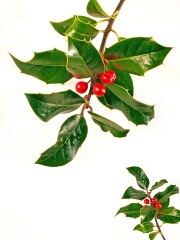
Holly, Ivy and Greenery
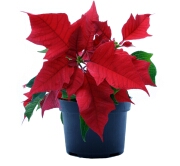
Poinsettias
The Candy cane
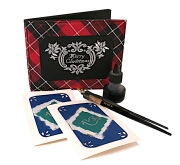
According to the National Confectioner’s Association, in 1847 German immigrant August Imgard used the candy cane to decorate a Christmas tree in Wooster, Ohio. More than 50 years later, Bob McCormack of Albany, Georgia supposedly made candy canes as treats for family, friends and local shopkeepers. McCormack’s brother-in-law, Catholic priest Gregory Keller, invented a machine in the 1950s that automated the production of candy canes, thus eliminating the usual laborious process of creating the treats and the popularity of the candy cane grew. More recent explanations of the candy cane’s symbolism hold that the color white represents Christ’s purity, the red the blood he shed, and the presence of three red stripes the Holy Trinity. While factual evidence for these notions does not exist, they have become increasingly common and at times are even represented as fact. Regardless, the candy cane remains a favorite holiday treat and decoration. Christmas cards
Rudolph the Red-nosed Reindeer
Writing in verse as a series of rhyming couplets, May tested the story as he went along on his 4-year old daughter Barbara, who loved the story Sadly, Robert Mays wife died around the time he was creating Rudolph, leaving Mays deeply in debt due to medical bills. However, he was able to persuade Sewell Avery, Montgomery Ward’s corporate president, to turn the copyright over to him in January 1947, thus ensuring May’s financial security. May’s story “Rudolph the Red-Nosed Reindeer” was printed commercially in 1947 and in 1948 a nine-minute cartoon of the story was shown in theaters. When May’s brother-in-law, songwriter Johnny Marks, wrote the lyrics and melody for the song “Rudolph the Red-Nosed Reindeer”, the Rudolph phenomenon was born. Turned down by many musical artists afraid to contend with the legend of Santa Claus, the song was recorded by Gene Autry in 1949 at the urging of Autry’s wife. The song sold two million copies that year, going on to become one of the best-selling songs of all time, second only to Bing Crosby’s “White Christmas”. The 1964 television special about Rudolph, narrated by Burl Ives, remains a holiday favorite to this day and Rudolph himself has become a much-loved Christmas icon. Hanukkah
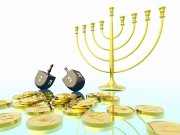
A search of the temple produced a small vial of undefiled oil — enough for only one day. Miraculously, the Temple lights burned for eight days until a new supply of oil was brought. In remembrance of this miracle, one candle of the Menorah – an eight branched candelabra – is lit each of the eight days of Hanukkah. Hanukkah, which means dedication, is a Hebrew word when translated is commonly spelled Hanukah, Chanukah, and Hannukah due to different translations and customs. The tradition of receiving gifts on each of the eight days of Hanukkah is relatively new and due in part to the celebration’s proximity to the Christmas season. Kwanzaa
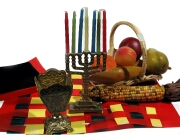
Three green candles are placed on the left, three red candles on the right and a black candle in the center, each candle representing one of the seven principles of the celebration. One candle is lit each day of the Kwanzaa celebration, beginning from left to right The colors of Kwanzaa ~ black, red and green ~ also have a special significance. Black symbolizes the faces of the African people, Red symbolizes the blood they have shed, and Green represents hope and the color of the motherland. The name itself – Kwanzaa – is a Swahili word meaning “fruits of the harvest.”
SOURCE: allthingschristmas.com |


.jpg)


.jpg)

501.944.4483